LTO Transfer of Ownership 2026: Requirements & Fees
By Mhariella Santos · Lead Writer & Editor
On this page
You bought the vehicle, paid the seller, and took it home — but the process isn't complete. In the Philippines, the Land Transportation Office (LTO) must officially transfer the vehicle registration to the new owner's name.
If you skip this step, the previous owner may still face traffic violations, toll penalties, or legal issues tied to the vehicle, while the buyer may struggle with registration renewal and future LTO transactions. This guide explains the complete process, including the latest 2026 rules, requirements, fees, and penalties. After transferring, you can confirm your new records with our LTO Tracker guide.
What Is LTO Transfer of Ownership?
It is the legal process of updating the LTO database to reflect a vehicle's registration from the old owner to the new owner. It applies to a private sale, donation, inheritance, company transfer, or any other legal transaction.
Until the records are updated, the previous owner may still be responsible for traffic violations, toll fees, congestion penalties, and some legal liabilities — and the buyer may face problems renewing the vehicle registration.
The New 2026 Rule You Need to Know
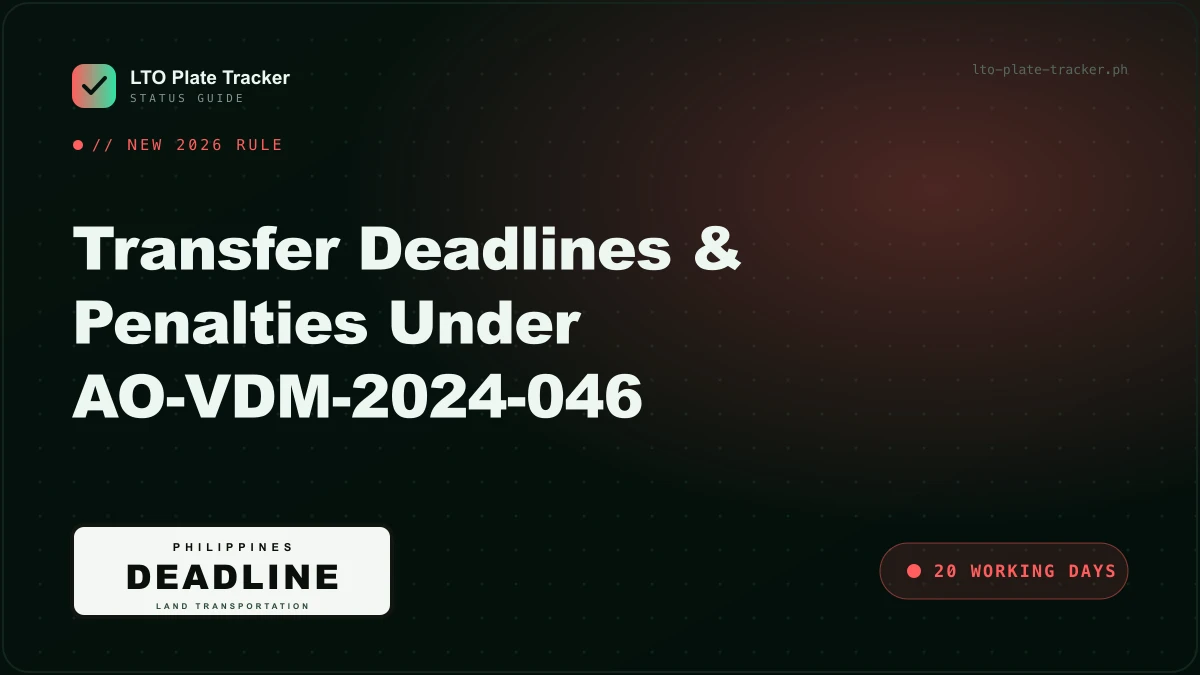
The LTO changed the transfer process under Administrative Order No. AO-VDM-2024-046. Under the updated rules:
- Sellers must report the sale within 5 days.
- Buyers must complete the transfer within 20 working days.
- Failure to comply can result in a ₱20,000 fine per person — up to ₱40,000 combined.
- The vehicle may also receive an "alarm tag" in the LTO system, which blocks future transactions.
These rules took effect on May 24, 2025, and apply to cars, SUVs, motorcycles, and commercial vehicles. Outstanding fines can also complicate the transfer, so review the LTO violations and penalties guide first.
Complete List of Requirements
Basic Documents Required
- Original OR/CR
- Notarized Deed of Sale
- Valid government IDs of the buyer and seller
- CTPL insurance in the buyer's name
- Emission test certificate
- PNP-HPG clearance
- Photocopies of all documents
Closed Deed of Sale Requirement
Open deeds of sale are no longer accepted. The buyer's full information must already be written on the deed before submission to the LTO.
Additional Requirements for Financed Vehicles
If the vehicle was financed, secure a release of the chattel mortgage, process cancellation at the Registry of Deeds, and present proof of loan settlement.
Requirements for Company-Owned Vehicles
If the seller is a corporation, a Secretary's Certificate is required to authorize the sale.
Step-by-Step LTO Transfer Process
Step 1: Prepare and Notarize the Deed of Sale
The Deed of Sale proves you bought the vehicle, showing buyer and seller names, vehicle details, price, and date. The LTO will not accept it without notarization (usually around ₱450). Remember an open deed of sale is no longer allowed.
Step 2: Get PNP-HPG Clearance
The PNP-HPG inspects your vehicle to confirm it isn't stolen or involved in a crime. Bring the vehicle, OR/CR, valid IDs, carbon paper, and a pencil — they stamp the engine and chassis numbers on paper, and if everything matches you receive a clearance certificate.
Step 3: Undergo Emission Testing
Your vehicle must pass an emissions test at an LTO-accredited PETC. If it passes you get an Emission Test Certificate; if not, fix the problem and test again.
Step 4: Secure CTPL Insurance
You need CTPL insurance before the LTO will approve the transfer — get it online, from insurance offices near the LTO, or from accredited agents. Make sure it is under the buyer's name.
Step 5: Clear Encumbrances (If Needed)
If the vehicle was bought through a loan, it may still have a chattel mortgage. Go to the Registry of Deeds, submit bank clearance documents, and request mortgage cancellation. Without this, the LTO will not allow the transfer.
Step 6: Visit the LTO Branch
Go to the LTO office where the vehicle is registered and bring your original documents, photocopies, IDs, insurance papers, HPG clearance, and emission certificate. Make sure all papers are complete to avoid a return trip.
Step 7: Submit Documents and Pay Fees
Give all documents to the LTO staff for checking. You may pay for the transfer fee, emission fee, insurance, and other charges. Preserve all official receipts as mandatory proof of compliance.
Step 8: Receive the New OR/CR
After approval, you'll receive a new Official Receipt (OR) and Certificate of Registration (CR) — the vehicle is now officially in your name. Keep these documents safe as proof of legal ownership, and you'll need them for your next LTO registration renewal. The LTO database can take a few days to reflect the change, so if the tracker still shows no record for your vehicle, see how to fix an LTO plate status "Not Found".
LTO Transfer Fees and Estimated Costs
The cost depends on the vehicle type and required documents. In most cases, motorcycles cost around ₱2,000 to ₱3,500, while cars usually cost around ₱3,000 to ₱5,000. These amounts include basic government processing and required steps.
The total usually covers the transfer fee, PNP-HPG clearance, deed notarization, emission testing, and CTPL insurance. Extra charges may apply for late-transfer penalties, registration renewal fees, mortgage cancellation, or document correction.
Special Situations
Transfer of Inherited Vehicles
An inherited vehicle cannot be transferred immediately without legal documents. The family must provide proof of death (a PSA death certificate) and prepare an Extra-Judicial Settlement of Estate; estate tax documents are sometimes required. Because this involves legal matters, many people seek help from a lawyer.
Motorcycle Transfer Rules
Motorcycle transfers follow strict rules to prevent illegal sales. The transfer must be completed within 20 working days, or the buyer may face penalties of up to ₱5,000 and the vehicle may be flagged in the LTO system.
Used Car Dealer Transactions
Used car dealers must now transfer the vehicle directly to the real buyer's name — it can no longer stay under the dealer's or previous owner's name for an extended period. This helps prevent fraud and ensures correct ownership records.
Practical Tips to Avoid Delays
- Bring extra photocopies of all important documents (OR/CR, IDs, insurance, Deed of Sale).
- Check whether the vehicle has an active loan or chattel mortgage before going to the LTO.
- Make sure all details match exactly — names, addresses, signatures, and vehicle information.
- Never engage with fixers; illegal shortcuts add legal risk and penalties.
- Use the LTMS Portal to register online, upload documents, book appointments, and track your transaction.
Frequently Asked Questions
How many days do I have to transfer ownership?
The buyer must complete the transfer within 20 working days from the purchase date.
What happens if I fail to transfer ownership?
You may face ₱20,000 penalties, an alarm tag in the LTO system, and problems renewing registration.
Can I transfer ownership without the original owner?
Usually the seller's documents and signatures are required. Some special cases may need additional legal documents.
Is an open deed of sale allowed in 2026?
No. Open deeds of sale are no longer accepted by the LTO.
Conclusion
LTO transfer of ownership is a legal requirement in the Philippines. Whether you bought a second-hand car or motorcycle or inherited a vehicle, the records must match the actual owner. With stricter 2026 rules and large penalties, process the transfer immediately — prepare documents early and finish within the 20-working-day period. Afterward, keep everything current with our LTO registration renewal guide and confirm your status using the LTO Tracker.
Related guides
How to Retrieve Your LTO Portal Account (2026 Guide)
Learn how to recover your LTMS account, reset your password, restore email or client-number access, and regain LTO Portal login fast with this step-by-step 2026 guide.
Read guide
LTO Plate Status Not Found: How to Fix It in 2026
Seeing "Not Found" on your LTO plate tracker? Learn why it happens and the exact step-by-step fixes — from using your MV File Number to visiting your LTO branch.
Read guide
LTO Violations & Penalties 2026: Complete Fine List
The complete 2026 LTO violations and penalties list — updated fines, the 15-day settlement rule, demerit points, license suspension triggers, and how to pay.
Read guide